South America

Cuzco's Plaza de Armas as seen from the Church of the Society of Jesus. The city is surrounded by beautiful hills whose lights twinkle at night.

Cuzco’s Plaza de Armas as seen from the Church of the Society of Jesus. The city is surrounded by beautiful hills whose lights twinkle at night.

Cuzco is a great city. We were here in 2009 for just a day, part of a tour to hike the Inca Trail. We were enchanted and knew we needed to come back to do the city justice.

What’s so great about it? Well, for one thing it’s the belly button of the world, or at least so the Incas believed. It was their capital from the 13th century until the Spanish overthrew them in the 16th century. The conquering Spaniards, led by Francisco Pizzaro, were astonished by the city’s beauty, according to one author, and they made it the capital of their Andean empire building beautiful churches and other important buildings. Sitting a little over 11,000 feet above sea level (thank goodness we’ve had weeks at relatively high altitudes to prepare us) Cuzco is a center for great hiking and other adventures and just an all around beautiful city.

The Plaza, with the Cathedral on the left and the Jesuit church on the right

The Plaza, with the Cathedral on the left and the Jesuit church on the right

There’s a fun story about the great churches in Cuzco. If you go to the central square, the Plaza de Armas, there are not one but two giant churches. One, it turns out, is the Cathedral as is typical of Spanish colonial squares, built in the 16th century only a couple decades after the conquest. The other is the Iglesia de la Compañía de Jesús, the Church of the Society of Jesus, built by the Jesuits also in the 16th century. (As though it’s not odd enough having two huge churches on adjacent sides of the square the Cathedral complex is actually made up of three separate-but-connected churches.)

Cuzco had some absolutely great restaurants which, after a pain-killing Manhattan, I could enjoy. This was an antipasto plate for about $10 that was amazing.

Cuzco had some absolutely great restaurants which, after a pain-killing Manhattan, I could enjoy. This was an antipasto plate for about $10 that was amazing.

After the Jesuit church was substantially damaged in a 1650 earthquake they decided to rebuild it as the most magnificent church in Cuzco. The Bishop, ensconced in the Cathedral, objected and complained to the Pope himself that the Jesuits should not be allowed to outshine the Cathedral’s splendor. The Pope ruled in the Bishop’s favor but by they the Jesuit church was nearly complete, and magnificent it was.

So there you are, two grand churches just a stone’s throw from each other. And grand they are. The Cathedral compares well with nearly any of the great European churches and has an enormous collection of colonial art from what is known as the Cuzco School. The favorite is a local rendition of the Last Supper, with Jesus and the Apostles all prepared to dine on a roasted guinea pig, a local favorite. Meanwhile, the Jesuit church nearby boasts the city’s biggest altar, a huge dome, and a beautiful baroque facade. Enough church to go around for everyone.

You're not allowed to take pictures inside the Cathedral, so I copied this off the web. You have to love that guinea pig in the middle of the table, though it looks as though it's not really big enough for the 13 of them. According to a worker inside the church that guy on the right foreground is supposed to be not Judas but Francisco Pizzaro, the conquerer of the Incas.

You’re not allowed to take pictures inside the Cathedral, so I copied this off the web. You have to love that guinea pig in the middle of the table, though it looks as though it’s not really big enough for the 13 of them. According to a worker inside the church that guy on the right foreground is supposed to be not Judas but Francisco Pizzaro, the conquerer of the Incas.

Oh, and one other great thing about city: Cuzco’s flag is a rainbow flag, pretty much identical to the gay banner used in much of the rest of the world. What could make us feel more welcome than seeing rainbow flags flying over so many restaurants and bars and public spaces?

OK, then, if it’s such a great place why do I call it a missed opportunity. To start with, we came here right after a tough two-day hike down into and back out of the Colca Canyon and our legs just hurt. We can both climb uphill pretty well, but those downhills – thousands of feet down into the canyon – were killers. Every step for the first couple days was painful not unlike, I would guess, someone who’s just run his or her first marathon.

One more food picture. Here we have an octopus tiridito, another great dish.

One more food picture. Here we have an octopus tiridito, another great dish.

But then to add insult to injury – or greater injury to injury, as the case may be – a pinched nerve, last observed in France nearly two years ago, reappeared. I had felt a bit of pain before starting the canyon hike but decided to do the hike anyway. In fact, it gave me no problem whatsoever; it seemed to go away on it’s own. In Cuzco, though, it struck back in some force. Not the same lying on the floor screaming in agony as I experienced in Poitier, but really painful. Enough so there was no way I could enjoy exploring the city or even thinking of going on another hike. Instead I spent part of all three full days we were in Cuzco in a 24-hour clinic getting shots, an IV, and some anti-inflammatory medicine. Apparently, though, prescriptions for pain are unknown in Peru, or at least unavailable. Sad, because while I didn’t need morphine or anything that strong I could definitely have used something for a couple days.

So that was Cuzco, a city of great architecture, beautiful churches, amazing restaurants, and at least one clinic where the staff spoke English. A great city that we just didn’t get to enjoy that much. From here we’re headed deeper into the Sacred Valley – as this part of Peru was known to the Incas – to Urubamba, and then on to Lake Titicaca. Stay tuned.

A view of the grand Jesuit church

A view of the grand Jesuit church

Another shot from the Plaza de Armas with the baroque facade of the Jesuit church in the background

Another shot from the Plaza de Armas with the baroque facade of the Jesuit church in the background
Colca Canyon from near the top of our hike. We would hike 4,000 feet down to that river … and then back up.

Colca Canyon from near the top of our hike. We would hike 4,000 feet down to that river … and then back up.

One of the major attractions of going to Arequipa, besides seeing the city itself, is that it’s reasonably close to the Colca Canyon and the major jumping off spot for tours there. Formed by the Colca River, the canyon is over 10,700 feet deep; twice as deep as the Grand Canyon and one of the deepest canyons in the world. As Lonely Planet puts it, “Going to Arequipa and missing out on the Colca Canyon is like going to Cuzco and neglecting to visit Machu Picchu.”

A view of Colca Valley, just before the start of the canyon

A view of Colca Valley, just before the start of the canyon

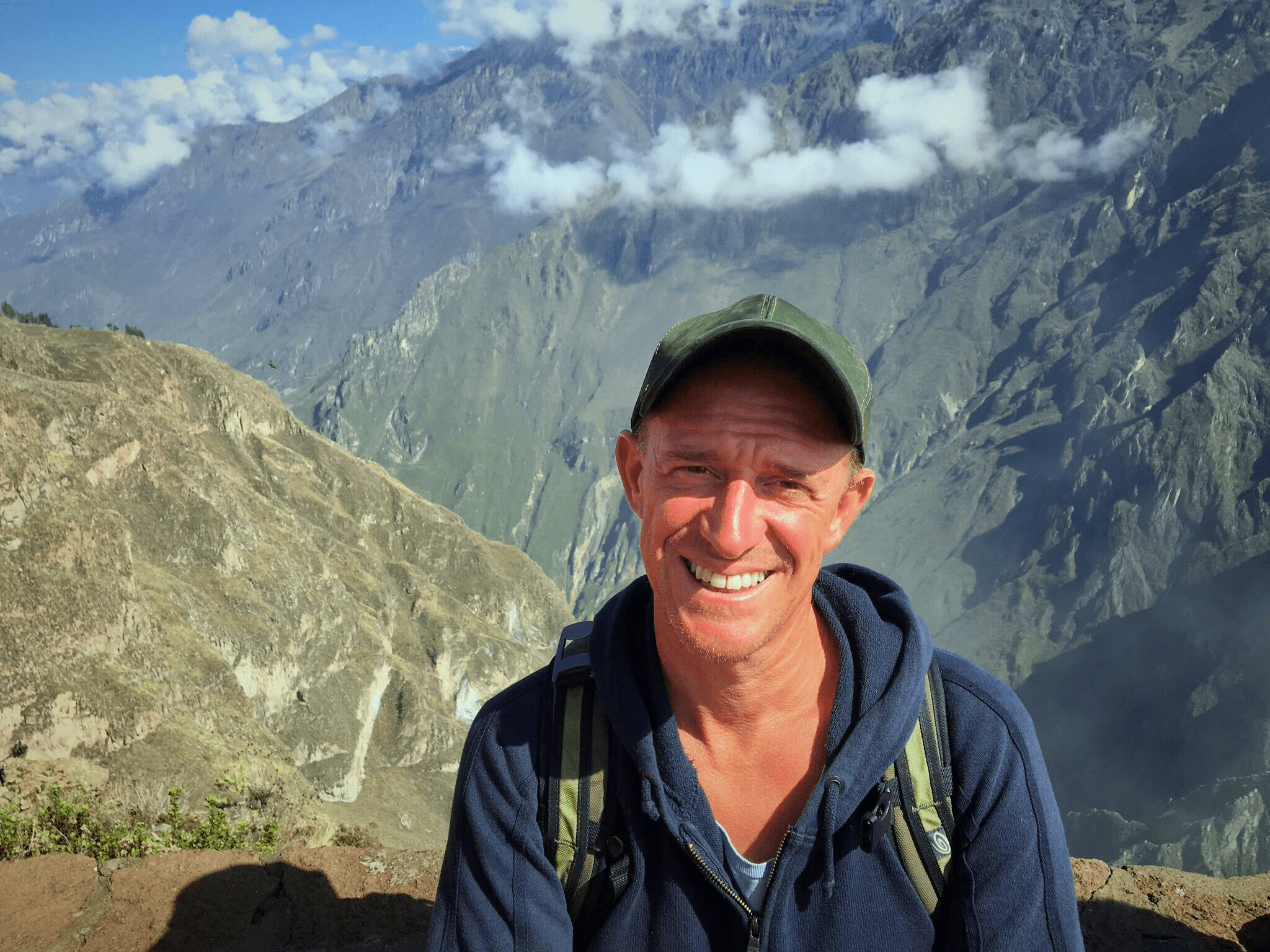
Mark enjoying a view of the canyon

Mark enjoying a view of the canyon

So off we went. There are a couple options for going to the canyon from Arequipe. One is to do it as a day trip: a three hour bus ride out there, a couple hours driving around and stopping at view points, and a three hour ride back. That sounds like a pretty good description of hell to us, so we took the other option, a two day trip including a long hike down into the bottom of the canyon on the first day and a really long hike back up out of the canyon on the second day.

Now, this option had its drawbacks, including the fact that you still have the three-hour bus rides on each day. And that the bus picks you up on day one from your hotel at 3:00 AM. Yup, 3:00 AM so you can get to a town near the canyon for breakfast, stop at a viewpoint to watch Andean condors soaring, and still hit the trailhead by 9:30 or so.

Fortunately the bus was reasonably small and comfortable, maybe 16 people or so, and we could finish our night’s rest before getting to the Colca region for breakfast. To say that breakfast was light, though, would be a bit of an understatement: it consisted of bread, butter, and a little strawberry jam. Local bread, very tasty, but still not a lot to fuel a long hike.

From there it was on to Cruz del Cóndor, nearly 4,000 feet above the canyon floor, where a family of Andean condors nest and soar. They’re a beautiful bird to watch as they swoop and soar around the rim of the canyon, their 10-foot wingspan making them pretty recognizable. Amusingly, though, when you see close-up pictures of them they’re kind of ugly. They are, in fact, a kind of vulture who feed not on little animals they spy like eagles do, but on dead animals, preferably big carcasses like deer and cattle. While the Andean condor is one of the longest-living birds, with life spans of up to 70 years, it has been on the U.S. Endangered Species list since the 1970s.

From Cruz del Cóndor you can see those specks in the middle of the photo. They were sometimes closer, but I never managed to get a picture then.

From Cruz del Cóndor you can see those specks in the middle of the photo. They were sometimes closer, but I never managed to get a picture then.

After a brief stop to watch the condors, then, it was off to the trail head. There’s not a lot to say about the trail except that it was a L-O-N-G route down to the bottom of the canyon. And if anyone ever says “Yeah, but at least it was downhill,” let me be the first to say hiking up is easier than hiking down. While some of it was a beautiful and gradual slope, a lot of it was steep with loose rocks; you felt as though you could slip and fall at any second. But, wobbly though my legs were after the 4,000-foot descent, we made it to the bottom.

That's the "Oasis" a tiny village at the bottom of the canyon where we would spend the night. You can see the zig-zag trail leading up on the other side of the valley that we would hike up the next morning.

That’s the “Oasis” a tiny village at the bottom of the canyon where we would spend the night. You can see the zig-zag trail leading up on the other side of the valley that we would hike up the next morning.

Lunch was this quiet, bucolic spot on the edge of the canyon

Lunch was this quiet, bucolic spot on the edge of the canyon

From there it was an up-and-down route first to lunch and then back down to the bottom of the canyon where we spent the night. Now, we knew the accommodations weren’t going to be our normal standards; the price we were paying suggested this was going to be backpacker style instead. One of the things we learned was that we’re really not cut out to be backpackers. Rustic indeed. It’s not just that our cabin didn’t have plumbing or a bathroom, it didn’t have electricity. Yikes – nowhere to plug in our phones (which are also our cameras) or iPads. No towels provided, though the cold showers available weren’t that enticing anyway. Not even toilet paper, to be honest. Yeah, that’s basic. Still, it was lovely down there in the bottom of the canyon.

Then it’s up at 4:45 or so to start the hike out of the canyon by 5:00. Still dark, but fortunately we’re smart enough to travel with small flashlights. We know it’s going to be hard work, as the trail takes about three hours and is just up, up, up. Every step you take is up. But it was totally worth it. Going up is hard work, but – unlike going down – it never feels dangerous or particularly difficult. We started hiking under starlight but within 20 minutes or so daylight began breaking through and pretty soon you were watching daybreak in the canyon. Spectacular. And I’ll brag for just a bit: while the guidebook says it’s a 3-hour hike for normal hikers and two- to two-and-a-half hours for fit hikers, I did it in just slightly under two hours. There I was, passing up 20-something kids, feeling just fine.

Only then did we get breakfast. After that we stopped at a few small towns, had lunch, and then it was a long drive back. Fabulous scenery, got to know a few of our fellow hikers from Germany, Italy, Spain, Bulgaria, Wales, and just in general a great way to spend two days. After a night back in Arequipa, then, it’s off to Cuzco.

That's me and our guide Ivan on a leisurely section of the hike

That’s me and our guide Ivan on a leisurely section of the hike

Hiking on Day 1 we got to this spot where just three days before there had been a bridge. Then there was rain … and no more bridge.

Hiking on Day 1 we got to this spot where just three days before there had been a bridge. Then there was rain … and no more bridge.

Recognizing the importance of tourist traffic, the locals had already built a temporary bridge so we could still do the hike

Recognizing the importance of tourist traffic, the locals had already built a temporary bridge so we could still do the hike

This 74-year old woman is selling tuna. We'd been confused in Mexico when we saw tuna ice cream for sale, but learned here that tuna is the name of a cactus fruit. She was selling them for about 10 cents each, though they were worth a LOT more than that; they were really good.

This 74-year old woman is selling tuna. We’d been confused in Mexico when we saw tuna ice cream for sale, but learned here that tuna is the name of a cactus fruit. She was selling them for about 10 cents each, though they were worth a LOT more than that; they were really good.

Early morning on Day 2 I've hiked out above the morning fog to see the sun getting ready to break through

Early morning on Day 2 I’ve hiked out above the morning fog to see the sun getting ready to break through

One of the local guides

One of the local guides

And here I am, two hours after starting, waiting for all those young 'uns to reach the top

And here I am, two hours after starting, waiting for all those young ‘uns to reach the top

Our little group of hikers - some Italians, Spaniards, and Bulgarians all come to explore Peru

Our little group of hikers – some Italians, Spaniards, and Bulgarians all come to explore Peru

After the hike, we stopped in a few little towns where you can always find a suffering Jesus

After the hike, we stopped in a few little towns where you can always find a suffering Jesus

And finally a last view of the valley as we leave the canyon

And finally a last view of the valley as we leave the canyon

One of the beautiful little streets in the Santa Catalina Monastery

One of the beautiful little streets in the Santa Catalina Monastery

Poor Arequipa. If you want a great urban experience in Peru, you go to Lima. If you want a great Andean experience, you go to Cuzco and Machu Picchu. As Peru’s second largest city, just one-tenth the size of Lima, Arequipa can be overlooked. Tis a pity, though, because it’s a vibrant, beautiful city with world-class hiking in the nearby Colca Canyon. High up in the Andes – the city sits at about 7,600 feet above sea level – Arequipa is also blessed with a wonderfully cool climate, with average summer highs (recall that it’s summer here) in the low 70s. Delightful.

Arequipa's cathedral right on the central plaza

Arequipa’s cathedral right on the central plaza

One of the most striking things about Arequipa is the local white sillar rock out of which much of the center part of the city is built. The result of volcanic eruptions, sillar is light, porous and easily carved, yet sufficiently strong to be the central element in construction. As a result buildings are beautifully white with great domes and vaults. The central core of Arequipa – particularly the baroque cathedral on the central plaza and the nearby Santa Catalina Monastery – was named a UNESCO World Heritage site in 2000.

One of the first sights you see on entering the monastery

One of the first sights you see on entering the monastery

Many of the buildings in the monastery have these great vaulted ceilings. This is part of the art collection on display.

Many of the buildings in the monastery have these great vaulted ceilings. This is part of the art collection on display.

While the central plaza is big, leafy, and surrounded by glorious sillar buildings, particularly the cathedral, the real star of Arequipa is the Santa Catalina (St. Catherine) Monastery. Built in the late 16th century with a decided Moorish style, the monastery for Dominican nuns is essentially a small, walled city within a city with five narrow streets connecting various parts and buildings. A couple dozen nuns still live in a newer section, but most of it is now open to the public. It is a site not to be missed.

One of the first things you notice as you tour the nun’s cells is that these were not poor women. Their quarters were surprisingly spacious, often with private kitchens and parlors separate from the bedroom. In fact, families had to pay a dowery of the equivalent of about $150,000 in today’s dollar. Women, we learned, owned their quarters and could and did sell them to other nuns. One of the women who entered, we read on the description of her cell, entered with a variety of possessions including one slave. Not the picture of nuns that I usually have.

And then there’s the food. We remembered from our trip to Peru in 2010 that the food here was great but I really didn’t remember it being this great. One lunch we had at a little place called Qaya was one of the great lunches I’ve ever had and sometimes it seemed as though there were no bad choices when it came to the restaurants.

We came here for four days, but spent nearly all of two of those days on a hiking trip up in the Andes a couple hours north. The time we spent in Arequipa, though, was pretty great. It’s funny; you just have no idea before getting to a new city like this if you’ll love it or be quickly bored. For every San Cristóbal (which we fell in love with) there’s a Paracas that’s, well, not so exciting. Arequipas was one of the great finds.

Mark inside the monastery

Mark inside the monastery

This beautiful park is part of the monastery but unfortunately was fenced off from tourists

This beautiful park is part of the monastery but unfortunately was fenced off from tourists

Mark loved the color contrast of this doorway. Amusingly, it's the entrance to the toilets.

Mark loved the color contrast of this doorway. Amusingly, it’s the entrance to the toilets.

Another street view

Another street view

There were beautiful flowers, plants, and bushes all over

There were beautiful flowers, plants, and bushes all over

And ornate doors

And ornate doors

Little nooks and crannies everywhere

Little nooks and crannies everywhere

Of course, the monastery was a place for worship. Latin Americans love to emphasize Christ's suffering, as this bleeding Jesus attests to. And yes, that's Mark's reflection hovering over Him.

Of course, the monastery was a place for worship. Latin Americans love to emphasize Christ’s suffering, as this bleeding Jesus attests to. And yes, that’s Mark’s reflection hovering over Him.

And then there was the food. This is octopus covered in a garlic and olive sauce. In a word, extraordinary.

And then there was the food. This is octopus covered in a garlic and olive sauce. In a word, extraordinary.

One of the sillar-constructed buildings running along a side of the central plaza, with part of the cathedral in the background

One of the sillar-constructed buildings running along a side of the central plaza, with part of the cathedral in the background

And finally the view from our hotel's roof deck across the plaza to the cathedral.

And finally the view from our hotel’s roof deck across the plaza to the cathedral.